

Xfmea: FMEA and FMECA Software Tool


Expert support for all types of FMEA and FMECATM

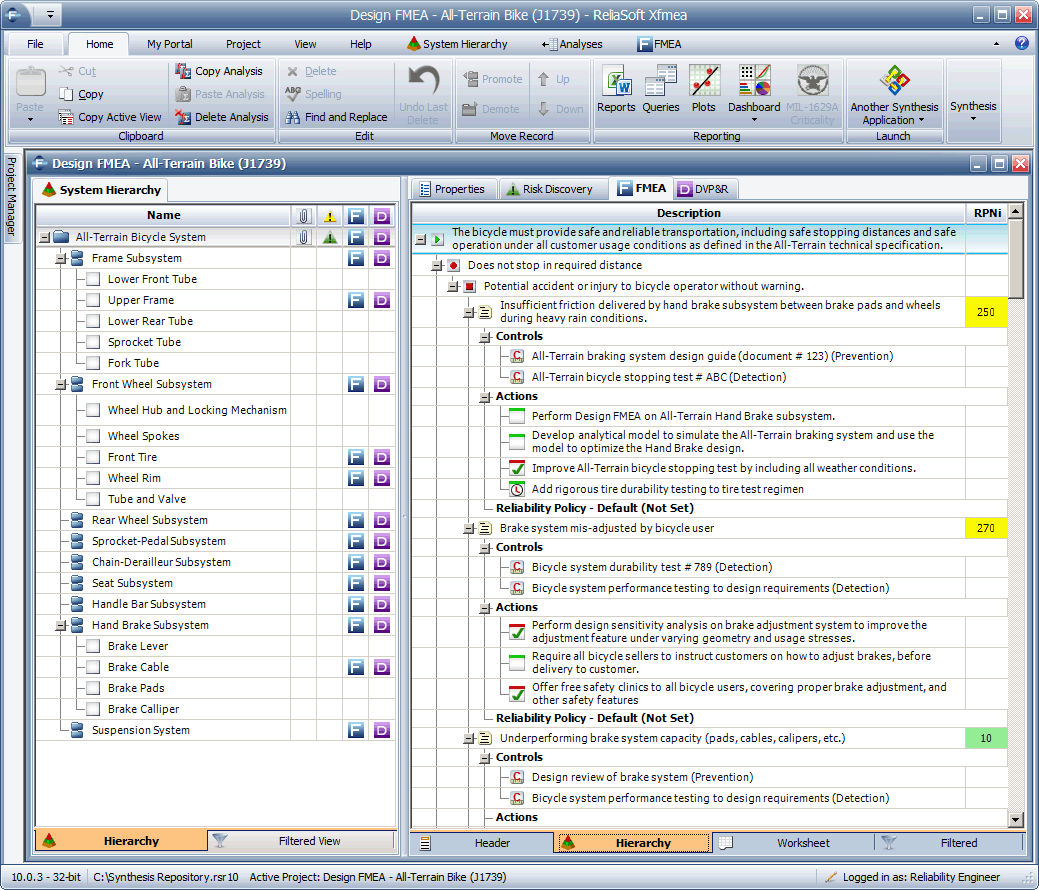
ReliaSoft’s Xfmea software tool facilitates data management and reporting for all types of Failure Modes and Effects Analysis — FMEA — and Failure Modes, Effects and Criticality Analysis — FMECA. The software provides predefined settings to fit the major industry standards (such as AIAG, SAE J1739 and MIL-STD-1629A) and also provides extensive customization options to fit your particular analysis and reporting needs.
Ready to learn more?

Software Features

Xfmea provides centralized data storage to make it easy for multiple users to cooperate on FMEA projects. The software offers a flexible and powerful set of tools to help you:

  • Record and manage data for current failure mode and effects analyses
  • (FMEAs).
  • Find and reuse relevant information from existing FMEAs.
  • Evaluate risk via RPN or Criticality Analysis.
  • Track the completion of recommended actions.
  • Present the FMEA data via reports, queries and charts.
  • Integrate the FMEA with related analyses, such as Process Flow Diagrams, Control Plans and Test Plans.

Synthesis Integration

With integration into the Synthesis Platform, analyses are now stored in a centralized database that supports simultaneous access by multiple users and shares relevant reliability information between Synthesis-enabled software tools. For enterprise-level repositories, both Microsoft SQL Server® and Oracle® are supported.

Available Training

ReliaSoft offers a five-day training seminar series that is composed of two sessions. D470A provides an overview of the fundamentals of effective FMEAs with hands-on practice using Xfmea for data management and reporting. D4780B uses case study examples to allow attendees to practice FMEA facilitation and application skills.

Benefits and Applications

Some of the potential applications and benefits of performing FMEA and related activities with ReliaSoft’s Xfmea software include the ability to:

  • Proactively consider potential failures, prioritize issues based on risk and then initiate improvements early in development when modifications tend to have the greatest impact for the lowest cost.
  • Create a keyword-searchable knowledge base of reliability-related information for your designs, which can contribute to the development of test plans, control plans, future design efforts and other activities.
    • The software makes it easy to find and reuse information from existing analyses or predefined libraries.
  • Establish consistency throughout the organization’s FMEA process and make it easy for multiple users to cooperate on the analyses.
  • Utilize charts, reports, automated e-mails and other features to use the analysis information in ways that will effectively support decision-making and make sure that corrective actions are implemented.

Software Capability Highlights

  • AIAG and SAE J1739
  • IEC 60812
  • ISO 14971
  • VDA-4 (German Automotive Industry)
  • MIL-STD-1629A
  • Highly configurable to define your own custom profiles

  • Design FMEA (DFMEA)
  • Process FMEA (PFMEA)
  • System FMEA
  • FMECA
  • Highly configurable to define your own custom profiles

  • Risk Priority Numbers (RPNs)
  • Criticality Analysis
  • Quantitative Consequence Priority Numbers (QCPNs)
  • Priority highlights and configurable risk ranking logic

  • Transfer DFMEA to PFMEA
  • DVP&R and Test Plans
  • Control Plans
  • Process Flow Diagrams and Worksheets
  • Design Reviews Based on Failure Mode

  • Easy to Build System Configurations
  • 3 Views for Data Entry
    • Hierarchy (Tree) View
    • Worksheet View
    • Filtered View

  • Browse or query to import existing data
  • Use keywords to find and import existing record descriptions (including new Smart Add tools)
  • Copy/paste and drag/drop

  • Custom Query Utility
  • Customized templates for imports, queries and reports
  • Change Log
  • Analysis Planning Tool
  • Links and Attachments
  • Find and Replace
  • Action alerts via e-mail, SMS text message or Synthesis portal message
  • Cause and Effect Diagrams

  • FMEA/FMECA Worksheets
  • Control Plan Worksheets
  • DVP&R Worksheets
  • DRBFM Worksheets
  • Other Tabular Reports (e.g., Causes by RPN, Actions by Due Date, etc.)

  • Bar Charts (e.g., Top 10 Failure Modes by RPN, Top 5 Effects by Severity, etc.)
  • Pie Charts (e.g., Actions by Status, Controls by Type, etc.)
  • % Reduction in RPN
  • Occurrence/Severity Matrix
  • FMEA/FMRA Dashboards

  • Microsoft Excel® – build and manage custom templates for import/export
  • Import from RCM++, RBI, MPC and XFRACAS

  • Microsoft Excel® and Microsoft Word®
  • Easily export to *.pdf, *.rtf or *.html from Word or Excel

  • Use published models to define the reliability characteristics of items
  • Work with a Failure Modes and Reliability Analysis (FMRA) that is synchronized with BlockSim
  • Use FMEA data to build fault trees in BlockSim
  • Share system configuration and failure mode data with XFRACAS
  • Export data from an MPC analysis
  • Push calculated/simulated reliability and availability to metrics

Latest Release
10.1.6 ♦ 24-Oct-2016


Contact Us | Live Chat | Technical Support 


Windows 7, 8, 8.1 or 10 Requirements 


Interface Languages: English, French, German, Portuguese, Spanish, Simplified Chinese


Training: D470, Quick Start Guide


Why Upgrade? New in Version 10


Pubs and Videos: