

 Our mission is to lead innovation by providing the most advanced solutions in reliability and sustainability to empower…
 REC is looking to the future by aligning business goals with Saudi Arabia’s 2030 Vision. Part of this is investing in our young people and their future.
 Reliability Expert Center was established with the strategic vision of spreading a reliability and sustainability culture across Saudi Arabia.




Download Example File for Version 10 (*.rsgz10) or Version 9 (*.rsr9)
Five turbine blades were tested for crack propagation. The test units were cyclically stressed and inspected every 100,000 cycles for crack length. Failure is defined as a crack of length 30 mm or greater.
Using Weibull++’s degradation analysis folio and Quick Calculation Pad (QCP), determine the B10 life for the blades using degradation analysiswith an exponential model for the extrapolation.
The following table shows the test results for the five units at each cycle.
| Cycle (x100) | Unit A | Unit B | Unit C | Unit D | Unit E |
| 100 | 15 mm | 10 mm | 17 mm | 12 mm | 10 mm |
| 200 | 20 mm | 15 mm | 25 mm | 16 mm | 15 mm |
| 300 | 22 mm | 20 mm | 26 mm | 17 mm | 20 mm |
| 400 | 26 mm | 25 mm | 27 mm | 20 mm | 26 mm |
| 500 | 29 mm | 30 mm | 33 mm | 26 mm | 33 mm |
Step 1: Using Weibull++, create a degradation analysis folio and enter the data into the data sheet. Select Exponential for the model and enter 30 for the critical degradation level. These settings will be used to extrapolate a failure time for each unit. To specify how the failure times will be analyzed, select 2P-Weibull for the life distribution and select MLE for the analysis method. After you calculate the folio, it will appear as shown next.
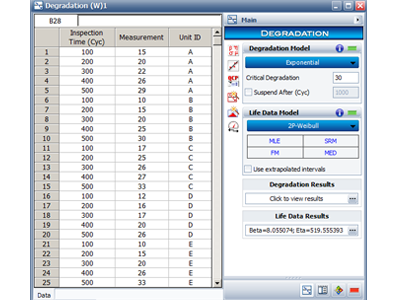
Figure 1: Degradation folio with data and results.
To view the parameters of the degradation model, click anywhere inside the Degradation Results area. The parameters will appear in the Results window, as shown next. (The second tab of the Results window shows the failure times that were extrapolated from the model.)
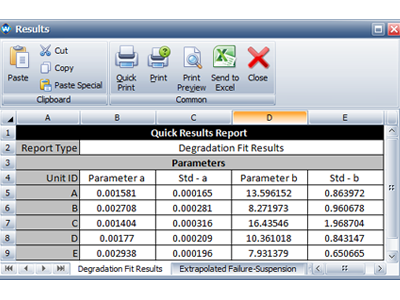
Figure 2: Results window showing the parameters of the degradation model.
Step 2: Next, view the linear Degradation vs. Time plot for the degradation analysis, as shown next. This plot shows how each unit degraded over time, and the horizontal pink line indicates the level at which a unit is considered failed.
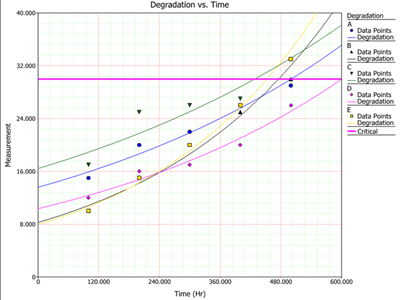
Figure 3: Degradation vs. Time (Linear) plot.

Figure 4: Results of life data analysis on the extrapolated failure times.
Step 4: Using the QCP, the B10 life is calculated to be 392.9179 (x100) cycles, as shown next.

Figure 5: Using the QCP to calculate the B10 life.