

 Our mission is to lead innovation by providing the most advanced solutions in reliability and sustainability to empower…
 REC is looking to the future by aligning business goals with Saudi Arabia’s 2030 Vision. Part of this is investing in our young people and their future.
 Reliability Expert Center was established with the strategic vision of spreading a reliability and sustainability culture across Saudi Arabia.




Download Example File for Version 10 (*.rsgz10) or Version 9 (*.rsr9)
The repairs made to a system are tracked over a period of time. Each repair is capable of addressing any damage accumulated up to the time of the current failure. The objective is to determine how effective the repairs are.
The table below displays the failure times for the system.
| 0.7 | 121.9 | 285 |
| 3.7 | 125.5 | 304 |
| 13.2 | 133.4 | 315.4 |
| 15 | 151 | 317.1 |
| 17.6 | 163 | 320.6 |
| 25.3 | 164.7 | 324.5 |
| 47.5 | 174.5 | 324.9 |
| 54 | 177.4 | 342 |
| 54.5 | 191.6 | 350.2 |
| 56.4 | 192.7 | 355.2 |
| 63.6 | 213 | 364.6 |
| 72.2 | 244.8 | 364.9 |
| 99.2 | 249 | 366.3 |
| 99.6 | 250.8 | 373 |
| 100.3 | 260.1 | 379.4 |
| 102.5 | 263.5 | 389 |
| 112 | 273.1 | 394.9 |
| 112.2 | 274.7 | 395.2 |
| 120.9 | 282.8 |
Step 1: Add a parametric recurrent event data analysis (RDA) folio to an existing project by choosing Insert > Folios > Parametric RDA.
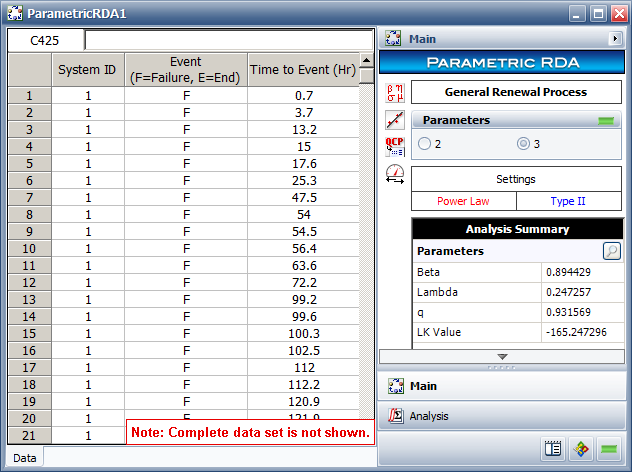
Step 2: Enter the data into the data sheet. Note that you must enter the final observation time twice: once as a failure (F) and once as the end event (E).
Step 3: On the control panel, select the 3 parameters options and the Type II virtual age model. Click Calculate to calculate the parameters. The results are shown next.
In ReliaSoft’s BlockSim software for system reliability, maintainability and availability analysis, the restoration factor, r, can be a number from 0 to 1, where 1 indicates that the block (component) is “as good as new” after the maintenance action (i.e., with a new age of 0) and 0 indicates that the block has not been improved at all by the maintenance action (i.e., with an age the same as the age before the maintenance was performed). A restoration factor of 0.5 implies a 50% improvement to the block and sets the age of the block to 50% of the age of the block at the time of the maintenance action. A restoration factor of 0.75 implies a 75% improvement to the block and sets the age of the block to 25% of the age of the block at the time of the maintenance action.
When you are using the Type II virtual age model in Weibull++’s parametric RDA folio, the restoration factor is equal to 1 – the q parameter. Thus, the restoration factor here is 0.0684, which implies a 6.8% improvement to the system.