
 Our mission is to lead innovation by providing the most advanced solutions in reliability and sustainability to empower…
 REC is looking to the future by aligning business goals with Saudi Arabia’s 2030 Vision. Part of this is investing in our young people and their future.
 Reliability Expert Center was established with the strategic vision of spreading a reliability and sustainability culture across Saudi Arabia.




Download Example File for Version 10 (*.rsgz10) or Version 9 (*.rsr9)
Consider the case of SALF vs. ACME, where SALF (Sue All Law Firm) is suing ACME (A Company Manufacturing Everything).
ACME considers offering SALF $2 million for an out of court settlement.
ACME can:
SALF can then:
Compute the probabilities of each outcome.
Define a variable to represent the total probability of ACME’s initial offer (100%), which will then be broken down into the probabilities of all possible outcomes.
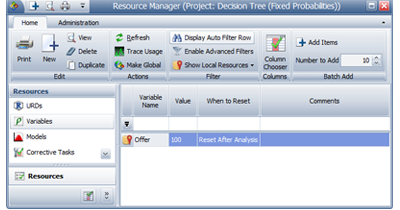
Construct the flowchart as follows:
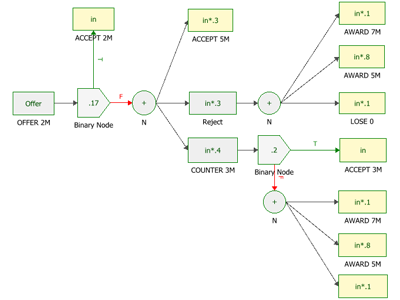
Step 1: Use a standard block to represent the probability of ACME’s $2 million initial offer.
Step 2: Use a binary node to evaluate whether SALF will accept the offer, as shown next.

If SALF accepts the offer, then the binary node will multiply the incoming value (100) by the probability value (0.17) and then pass the result to the “true” path. If SALF does not accept the offer, then the binary node will multiply the incoming value by the complement value of the probability (0.83) and then pass the result to the “false” path.
Step 3: Use a standard block and the RENO internal function called “in” to accept the value from the “true” path. This represents one possible final outcome, so you may wish to alter its color using the Block Style window so that it stands out.
Use a summing gate to accept and pass the output from the “false” path down multiple paths. The following picture shows the properties of the summing gate.
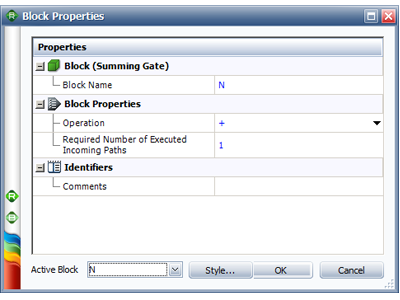
Step 4: Use three standard blocks to represent the probability that ACME will accept the $5 million counter offer, the probability that ACME will reject the offer, and the probability that ACME will re-counter at $3 million.
Step 5: If ACME rejects the offer, use three standard blocks to represent the probability of a 7M reward, a 5M award, or no reward. Use a summing gate to mark the point where the paths split.
Step 6: If ACME re-counters at $3 million, use a binary node to evaluate whether SALF will accept the counter offer. If SALF accepts, the binary node will multiply the incoming value by the probability value (0.2) and then pass the result to the “true” path. If SALF does not accept the offer, then the binary node will multiply the incoming value by the complement value of the probability (0.8) and then pass the result to the “false” path.
Step 7: Use a standard block and the RENO internal function called “in” to accept the value from the “true” path. This block represents the probability of a 3M reward.
Use a summing gate to accept and pass the output from the “false” path down to three standard blocks that represent the probability of a 7M reward, a 5M reward, or no reward.
Since all events here are represented with fixed probabilities, only one simulation is necessary. The following picture shows the results of the simulation in the flowchart (you can select the Show Block Values check box on the control panel to display the results).