
 Our mission is to lead innovation by providing the most advanced solutions in reliability and sustainability to empower…
 REC is looking to the future by aligning business goals with Saudi Arabia’s 2030 Vision. Part of this is investing in our young people and their future.
 Reliability Expert Center was established with the strategic vision of spreading a reliability and sustainability culture across Saudi Arabia.




When actual product reliability data is not available, standards based reliability prediction may be used to evaluate design feasibility, compare design alternatives, identify potential failure areas, trade-off system design factors and track reliability improvement. ReliaSoft’s Lambda Predict software tool supports failure rate predictions and mean time between failure predictions (MTBF predictions) based on the major reliability prediction standards, including MIL-HDBK-217 predictions, Bellcore predictions, Telcordia predictions, FIDES predictions and NSWC Mechanical predictions.
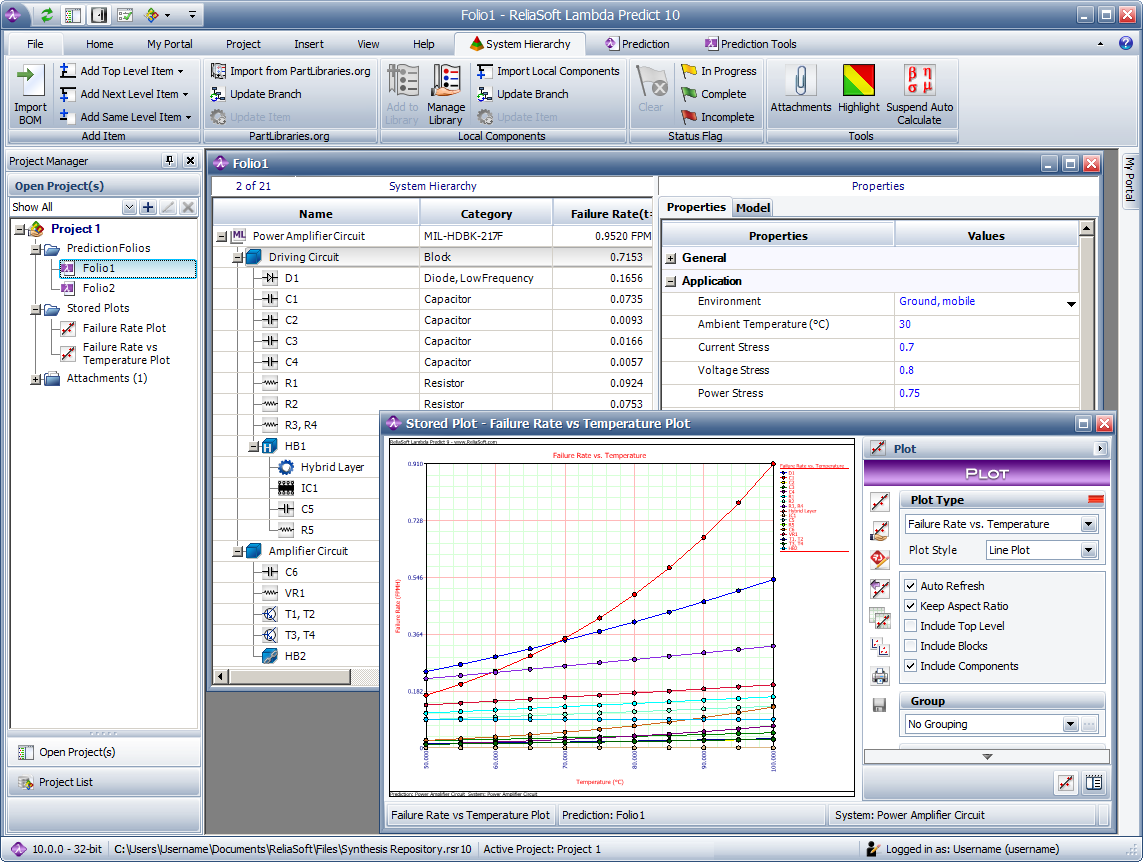
Lambda Predict makes it easy to build system configurations for analysis based on the MIL-HDBK-217-F (MIL-217), Bellcore/Telcordia, FIDES or NSWC Mechanical reliability prediction standards. The software provides a complete array of calculated results for your analyses (failure rate predictions, MTBF predictions, etc.) along with graphical charts and customizable reports. Lambda Predict offers a full set of supporting tools, including a reliability allocation utility, derating analysis and the ability to transfer and manage your data via flexible import/export utilities. The software also provides exclusive access to the PartLibraries.org website portal, which allows users to search and import parts data from MIL-M-38510, EPRD-97 or NPRD-95 (free to all users) as well as more than 300,000 specific commercial electronic components (yearly subscription required).
With integration into the Synthesis Platform, analyses are now stored in a centralized database that supports simultaneous access by multiple users and shares relevant reliability information between Synthesis-enabled software tools. For enterprise-level repositories, both Microsoft SQL Server® and Oracle® are supported.
ReliaSoft offers a two-day training course that introduces the subject of standards based reliability prediction. The seminar provides hands-on training in the use of the Lambda Predict software tool for building and analyzing system configurations in accordance with a published reliability prediction standard, with emphasis on MIL-HDBK-217F predictions, Bellcore predictions, Telcordia predictions, FIDES predictions and NSWC Mechanical predictions.
ReliaSoft’s Lambda Predict software provides a comprehensive platform for building and analyzing systems in accordance with published reliability prediction standards. Some of the many applications for using standards based reliability prediction techniques and Lambda Predict include the ability to:
Latest Release
10.1.6 ♦ 24-Oct-2016 | Update
Contact Us | Live Chat | Technical Support
Windows 7, 8, 8.1 or 10 Requirements
Interface Languages: English, French, German, Portuguese, Spanish, Simplified Chinese
Training: D490, Quick Start Guide
Why Upgrade? New in Version 10
Pubs and Videos: