
 Our mission is to lead innovation by providing the most advanced solutions in reliability and sustainability to empower…
 REC is looking to the future by aligning business goals with Saudi Arabia’s 2030 Vision. Part of this is investing in our young people and their future.
 Reliability Expert Center was established with the strategic vision of spreading a reliability and sustainability culture across Saudi Arabia.



ReliaSoft’s RGA is a powerful software tool that allows you to apply reliability growth models to analyze data from both developmental testing and fielded repairable systems. In the development stage, the software allows you to quantify the reliability growth achieved with each successive design prototype and also provides advanced methods for reliability growth projections, planning and management. For systems operating in the field, RGA allows you to calculate optimum overhaul times and other results without the detailed data sets that normally would be required for repairable system analysis.
The development of RGA was a joint effort between ReliaSoft Corporation and
Dr. Larry Crow, the leading authority in the field of reliability growth analysis, along with key development partners in government and industry. This collaboration has resulted in an application-oriented software package with all of the major reliability growth models, plus formulations that are not available anywhere else.
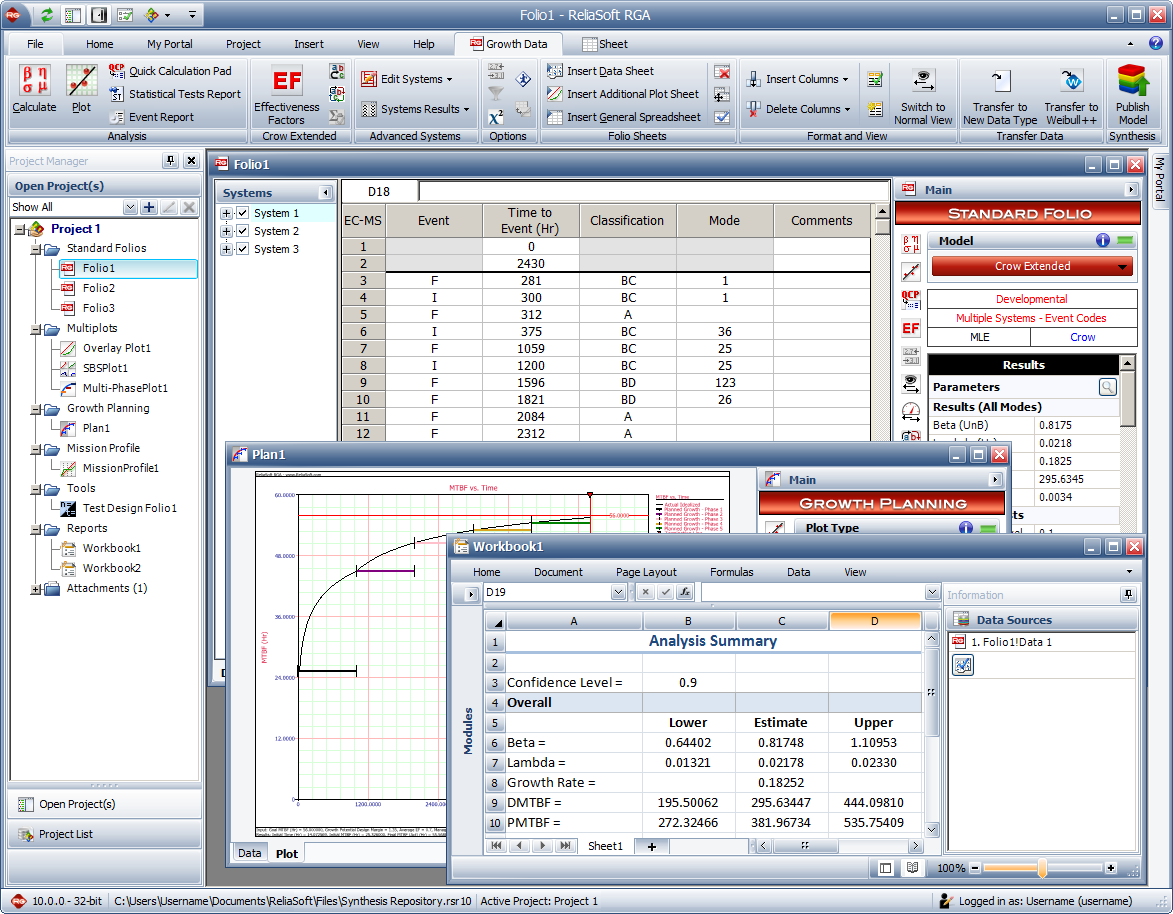
RGA includes full support for traditional reliability growth analysis using the applicable models — Crow-AMSAA (NHPP), Duane, Gompertz, Modified Gompertz, Lloyd-Lipow or Logistic — for a variety of developmental data types — time-to-failure, discrete (success/failure) and reliability data. In addition, the software provides exclusive support for innovative approaches that facilitate reliability growth projections, reliability growth program planning and multi-phase reliability growth analysis. RGA helps to create operational test plans that effectively balance all of the mission profiles that need to be tested to make sure the testing yields data appropriate for reliability growth analysis. The software also provides opportunities for fielded repairable system analysis, including a Design of Reliability Test (DRT) utility and a method for analyzing the system’s reliability behavior over time in order to calculate optimum overhaul times and other metrics of interest.
With integration into the Synthesis Platform, analyses are now stored in a centralized database that supports simultaneous access by multiple users and shares relevant reliability information between Synthesis-enabled software tools. For enterprise-level repositories, both Microsoft SQL Server® and Oracle® are supported.
ReliaSoft offers a comprehensive three-day training course that addresses the topic of applying reliability growth models to analyze developmental testing data and also fielded repairable systems. By combining a solid theoretical foundation with practical application examples and hands-on software training, this course will give you the knowledge and skills you will need to successfully apply these important reliability techniques.
ReliaSoft’s RGA reliability growth and repairable systems data analysis software provides a comprehensive platform for the application of reliability growth models for the analysis of both developmental test data and fielded repairable systems. Some of the many useful applications include the ability to:
Latest Release
10.1.6 ♦ 24-Oct-2016 | Update
Buy Applications Individually
Try | Buy
Course Prerequisites
Contact Us | Live Chat | Technical Support
Windows 7, 8, 8.1 or 10 Requirements
Interface Languages: English, French, German, Portuguese, Spanish, Simplified Chinese
Training: G511, Quick Start Guide
Why Upgrade? New in Version 10
Pubs and Videos: